Salah · the second pillar
How to Pray Salah
Yes — this is the beginner sequence for the five daily prayers. Start with wudu, face the qibla, make a silent intention, and say Allahu Akbar. One rakat is recitation, bowing, and two prostrations. Everything else is this, repeated and joined.
This page covers the common form used in most mosques worldwide. Madhab-specific details (hand placement, when hands are raised) belong with your local imam — we note the differences where they matter.
5 min read
What you need before you pray
Five conditions, and the prayer is not valid without them. The Prophet ﷺ said: “Allah does not accept the prayer of one who has broken his wudu until he performs wudu again” (Sahih al-Bukhari 135).
Here is the checklist. Thirty seconds, once, and it becomes second nature.
- Purity (wudu). Make wudu — or ghusl after major impurity. If you break wudu, renew it before praying.
- Clean clothes. For men, covered from navel to knee. For women, everything except face and hands, per the majority view.
- A clean place. A prayer mat is optional; a clean surface is not.
- Facing the qibla. The direction of the Kaaba in Makkah. Unsure? Our qibla finder sorts it in seconds.
- The time has entered. Each prayer has its window. Praying Dhuhr before the sun passes its zenith simply does not count. Check today's times.
One rakat, step by step
A rakat is one complete cycle: standing, bowing, two prostrations. Fajr is this cycle twice. Dhuhr and Asr, four times. Maghrib, three. Isha, four. Learn the cycle once and you have learned all five prayers.
1. Make the intention, then say Allahu Akbar
Stand facing the qibla. In your heart, know what you are about to pray — “two rakats of Fajr fard,” for example. No words needed aloud.
Raise your hands to your ears and say:
اللَّهُ أَكْبَرُ
Allahu Akbar
Allah is the Greatest.
This is the opening takbir, and from this moment you are in prayer. No talking, no looking around. Rest your right hand over your left.
2. The opening praise (Thana)
Sunna, not obligation. If you don't know it yet, keep praying and learn it gradually.
سُبْحَانَكَ اللَّهُمَّ وَبِحَمْدِكَ وَتَبَارَكَ اسْمُكَ وَتَعَالَىٰ جَدُّكَ وَلَا إِلَٰهَ غَيْرُكَ
Subhanaka Allahumma wa bihamdika, wa tabarakas-muka, wa ta'ala jadduka, wa la ilaha ghayruk.
Glory be to You, O Allah, and praise. Blessed is Your name, exalted is Your majesty. There is no god but You.
3. Recite Surah al-Fatiha
Say silently: A'udhu billahi mina sh-shaytani r-rajim (I seek refuge in Allah from the accursed Shaytan), then Bismillahi r-Rahmani r-Rahim. Then recite al-Fatiha — required in every single rakat:
الْحَمْدُ لِلَّهِ رَبِّ الْعَالَمِينَ، الرَّحْمَٰنِ الرَّحِيمِ، مَالِكِ يَوْمِ الدِّينِ، إِيَّاكَ نَعْبُدُ وَإِيَّاكَ نَسْتَعِينُ، اهْدِنَا الصِّرَاطَ الْمُسْتَقِيمَ، صِرَاطَ الَّذِينَ أَنْعَمْتَ عَلَيْهِمْ غَيْرِ الْمَغْضُوبِ عَلَيْهِمْ وَلَا الضَّالِّينَ
Alhamdu lillahi rabbi l-'alamin. Ar-Rahmani r-Rahim. Maliki yawmi d-din. Iyyaka na'budu wa iyyaka nasta'in. Ihdina s-sirata l-mustaqim. Sirata l-ladhina an'amta 'alayhim ghayri l-maghdubi 'alayhim wa la d-dallin. (Amin)
All praise is for Allah, Lord of the worlds. The Most Merciful, the Most Compassionate. Master of the Day of Judgement. You alone we worship, You alone we ask for help. Guide us to the straight path — the path of those You have favoured, not of those who earned anger, nor of those who went astray.
4. Add a short surah (first two rakats only)
After al-Fatiha in rakats one and two, recite another passage — al-Ikhlas, al-Falaq, or an-Nas are the beginner classics. Rakats three and four: al-Fatiha alone.
5. Ruku — bowing
Say Allahu Akbar and bow, back flat, hands gripping your knees. Say three times:
سُبْحَانَ رَبِّيَ الْعَظِيمِ
Subhana Rabbiya l-'Azim
Glory be to my Lord, the Most Great.
6. Rising from ruku
سَمِعَ اللَّهُ لِمَنْ حَمِدَهُ
Sami'a Allahu liman hamidah
Allah hears the one who praises Him.
Then, standing fully upright:
رَبَّنَا وَلَكَ الْحَمْدُ
Rabbana wa laka l-hamd
Our Lord, all praise is Yours.
7. Sujud — prostration
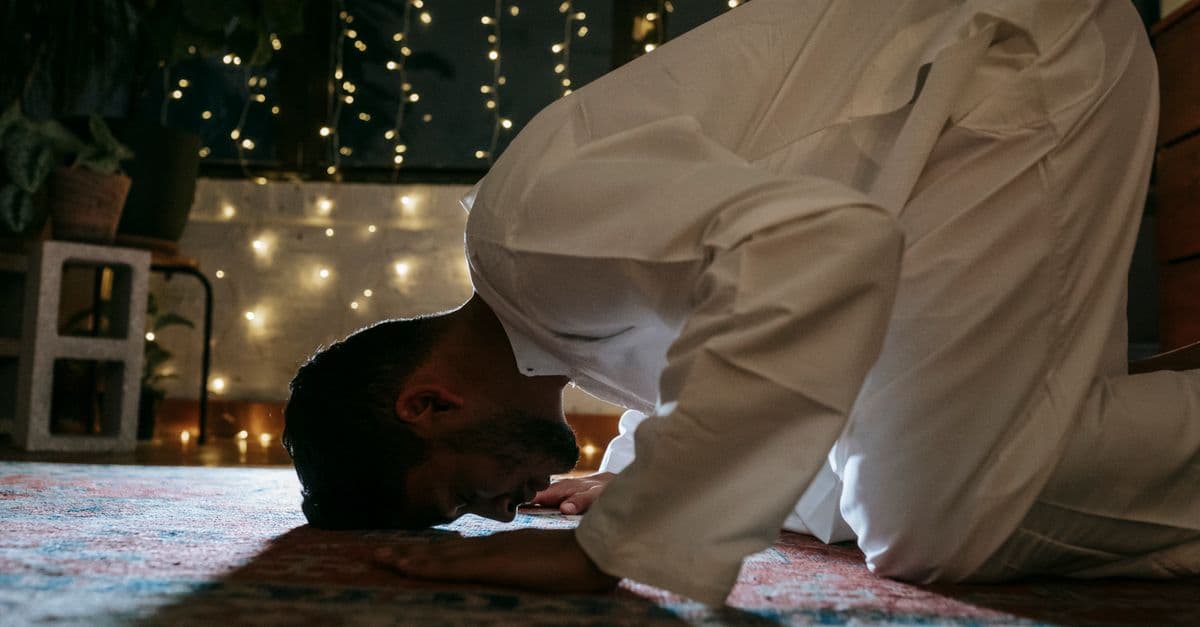
Say Allahu Akbar and go down. Seven points touch the ground: forehead and nose, both palms, both knees, the toes of both feet. Elbows up off the floor. Say three times:
سُبْحَانَ رَبِّيَ الْأَعْلَىٰ
Subhana Rabbiya l-A'la
Glory be to my Lord, the Most High.
This is the closest a servant gets to their Lord — the Prophet ﷺ said to make plenty of dua here.
8. Sit, then prostrate again
Rise saying Allahu Akbar, sit briefly on your left foot (right foot upright), and say:
رَبِّ اغْفِرْ لِي
Rabbighfir li
My Lord, forgive me.
Then Allahu Akbar, prostrate again, and repeat Subhana Rabbiya l-A'la three times. That is one rakat, complete.
Joining rakats into the five prayers
After the second rakat of every prayer, stay seated for the tashahhud — the full text lives on our Attahiyat page with transliteration and translation. Then:
- Fajr (2 rakats): after the second rakat, tashahhud + salawat on the Prophet ﷺ + close with salam. Done.
- Maghrib (3): after rakat two, the short tashahhud only, then stand. Rakat three is al-Fatiha alone. Sit, full tashahhud + salawat + salam.
- Dhuhr, Asr, Isha (4): same as Maghrib but with two extra rakats — al-Fatiha only in each — before the final sitting. (On Friday, Dhuhr is replaced by the congregational Jummah prayer.)
The closing salam: turn your head right, saying As-salamu 'alaykum wa rahmatullah, then left, repeating it. The prayer ends. Personal dua afterwards? Any language you like.
During Ramadan, an additional night prayer — taraweeh — is prayed after Isha. It is not one of the five daily obligatory prayers, but the same rakat structure taught above applies to each pair.
For the sunnah rakats that wrap around each fard — and the exact counts — see the prayer rakats chart. Witr after Isha has its own page: dua qunoot.
When you make a mistake
Everyone slips. The prayer has a built-in repair: sujud as-sahw — two extra prostrations before the final salam. Forgot a rakat? Added one? Act on what you believe is more likely, finish, add the two prostrations, done. Do not restart for a small recitation slip.
The mistakes worth actively guarding against:
- Rushing. Each position needs stillness — tuma'ninah is part of the prayer's validity, not decoration. One prayer prayed calmly beats five rushed. This is also exactly what khushoo is about.
- Praying before the time enters. Set accurate prayer times for your city.
- Speaking after the takbir. Anything other than the prescribed words breaks the prayer. If you genuinely forget and speak, redo your wudu-and-takbir — simply repeat the prayer.
- Saying the niyyah aloud. It lives in the heart. Full stop.
What if I don't know Arabic yet?
The recitations are in Arabic — that does not change. But the path there is shorter than you think: al-Fatiha is seven short verses, and most beginners have it in two to three weeks of nightly repetition. Use the transliterations on this page to train your tongue, and audio from any Quran app to train your ear.
Until then, keep praying with what you know and add one line at a time. Sincerity while learning covers the gap — the Prophet ﷺ's companions were learning too, once.
Frequently asked questions
Can I pray salah in English?
The obligatory recitations are Arabic; personal duas after the prayer are in any language. Learn via transliteration + audio, line by line.
How long does salah take?
Five to seven minutes for a four-rakat fard prayed with proper stillness. Fajr with its two sunnah: ten to fifteen.
What if I miss a prayer entirely?
Pray it the moment you remember — “whoever forgets a prayer, let him pray it when he remembers it” (Sahih al-Bukhari 597). No ritual, no penalty stack. Just make it up.
Which prayer should a beginner start with?
Whichever comes next. But many new Muslims start anchoring the habit with Fajr or Maghrib — our Fajr guide walks the two-rakat prayer in full.
Sumber teks
Teks Arab rasm Utsmani dan terjemahan Kementerian Agama Republik Indonesia, diambil langsung dari basis data quran.com — tidak diketik ulang. Rujukan hadits: Sahih al-Bukhari 135, 597, 631, 812; Sahih Muslim. Position sequence follows the common form taught in most mosques; madhab-specific details should be confirmed with a qualified scholar. (penomoran sunnah.com).