The practice
What is Muhasaba (Muhasabah)?
The Islamic practice of daily self-accounting — and why scholars called it the foundation of the spiritual path.
By Zaman Ishtiyaq, founder of Muhasaba · Updated August 2026

15 min read
In this guide
- 01The Quranic and Prophetic Foundation
- 02Muhasaba or muhasabah? Spelling and pronunciation
- 03The Nafs — What Muhasaba Is Accounting For
- 04How Classical Scholars Practised It
- 05The Three Steps of Muhasaba
- 06The Morning–Evening Loop
- 07How to Begin Tonight
- 08A Dhikr to Close
- 09Muhasaba vs Muraqaba
- 10How Muhasaba Differs from Western Journaling and CBT
- 11Common Mistakes in Muhasaba
- 12A Worked Example
- 13Questions About Muhasaba
Definition
Muhasaba (Arabic: محاسبة, pronounced moo-HA-sa-ba) is the Islamic practice of daily self-accounting: reviewing your deeds, intentions, and character before Allah at the end of each day. The full term, muhasabat al-nafs, means “taking account of the soul.” Scholars consider it a foundation of Islamic spiritual development.
In practice it takes five to fifteen minutes and is most commonly done after Isha prayer, when the day is complete enough to review honestly. The practice is not about guilt — it is about clarity: naming where you fell short, and equally naming where you did well and giving thanks for it. What distinguishes muhasaba from ordinary self-reflection is that the account is taken before Allah rather than before yourself, and that it is kept daily rather than only after failure. Umar ibn al-Khattab, Al-Ghazali, and Ibn al-Qayyim all treated it as a standing discipline rather than an occasional exercise.
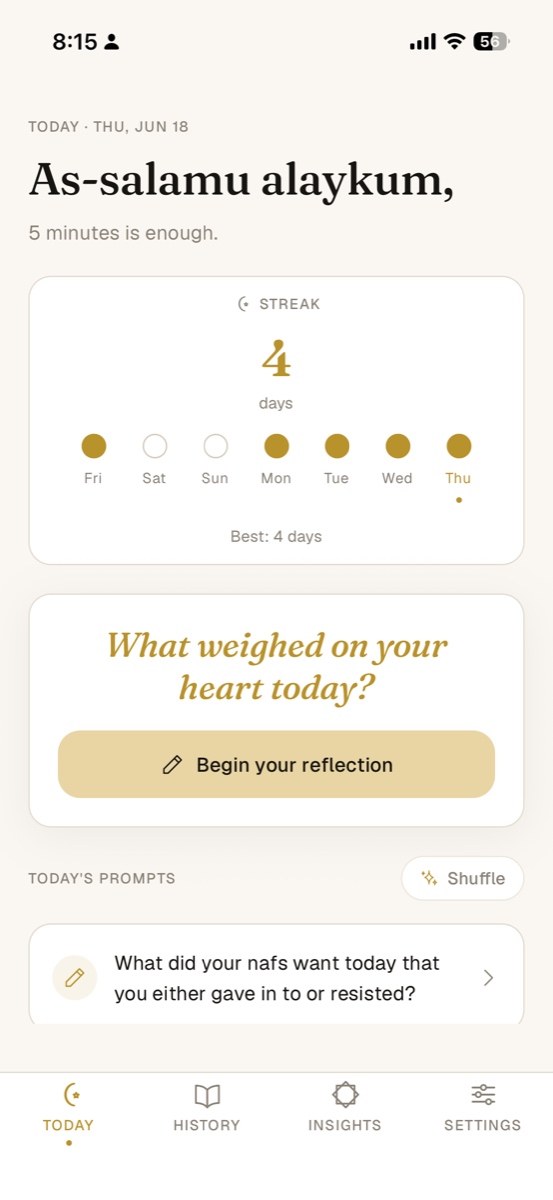
This guide explains muhasaba the practice. Muhasaba is also an iOS app for Islamic journaling, built around this practice.
Muhasaba (Arabic: محاسبة, also written muhasabah, muhasabat, or muhaseba in Turkish) literally means accounting or reckoning. In Islamic spirituality, muhasaba al-nafs — self-accounting — refers to the daily practice of examining your own deeds, intentions, and character before Allah. It is the honest review at the end of each day: what did I do well? Where did I fall short? What will I carry forward? In Malay and Indonesian, the practice is called muhasabah diri and is widely taught in Southeast Asian Islamic education.
The practice is not about guilt. It is about clarity. A merchant reviews the day’s accounts before closing the shop — not to punish himself, but to know exactly where he stands. Muhasaba works the same way. You review before sleep with the same honesty, and with the mercy that Allah has already shown you.
The Quranic and Prophetic Foundation
Allah says in Surah Al-Hashr (59:18):
يَا أَيُّهَا الَّذِينَ آمَنُوا اتَّقُوا اللَّهَ وَلْتَنظُرْ نَفْسٌ مَّا قَدَّمَتْ لِغَدٍ
Yā ayyuhā alladhīna āmanū ittaqū Allāha waltanẓur nafsun mā qaddamat lighad
“O you who believe, fear Allah, and let every soul consider what it has sent forward for tomorrow.” — Quran 59:18
The Arabic verb waltanzur — from nazara, to look and consider deliberately — commands a conscious review. Not a glance. A reckoning. This is muhasaba: examining what your hands have sent ahead before the day ends.
الْكَيِّسُ مَنْ دَانَ نَفْسَهُ وَعَمِلَ لِمَا بَعْدَ الْمَوْتِ
Al-kayyisu man dāna nafsahu wa ʿamila limā baʿd al-mawt
“The intelligent person is the one who takes account of himself and works for what comes after death.”
Umar ibn al-Khattab (رضي الله عنه), the second Caliph of Islam, practised muhasaba as a defining discipline of his life. His instruction, transmitted by al-Hasan al-Basri and recorded in Ibn Abi al-Dunya’s Muhasabat al-Nafs (no. 1): “Take account of yourselves before you are called to account, and weigh your deeds before they are weighed for you.” He understood that the voluntary accounting of this life is far more merciful than the compelled accounting of the next.
Muhasaba or muhasabah? Spelling and pronunciation
Both spellings are correct. The Arabic word is مُحَاسَبَة (mu-ḥā-sa-ba). Written without the final tāʾ marbūṭa sound it becomes muhasaba; with it, muhasabah. Malay and Indonesian writers usually keep the h (muhasabah diri), English-language scholarship usually drops it, and the transliteration mohasaba reflects Egyptian and Levantine pronunciation. The full phrase is muhasabat al-nafs, “taking account of the self”. Whichever spelling you use, the practice is the same: the nightly reckoning that Umar ibn al-Khattab described and that evening muhasaba turns into a five-minute habit.
The Nafs — What Muhasaba Is Accounting For
The term muhasabat al-nafs is deliberate. Nafs (نفس) means soul or self. Muhasaba is not a review of your schedule. It is an accounting of your soul. The Quran describes the nafs as passing through three states — and understanding them explains why the practice matters so much.
Stage one — Nafs al-ammara
إِنَّ النَّفْسَ لَأَمَّارَةٌ بِالسُّوءِ
Inna an-nafsa la-ammāratun bis-sūʾ
“Indeed, the soul persistently commands to evil.” — Quran 12:53. The default state: pulled toward impulse, heedlessness, and desire without reflection.
Stage two — Nafs al-lawwama (the soul that does muhasaba)
وَلَا أُقْسِمُ بِالنَّفْسِ اللَّوَّامَةِ
Wa-lā uqsimu bin-nafs il-lawwāmah
“And I swear by the self-reproaching soul.” — Quran 75:2. The soul that sees its own shortcomings and holds itself to account. This is precisely nafs al-lawwama performing muhasaba. Allah swears by it — which is the Quranic signal that this is the state worth reaching.
Stage three — Nafs al-mutmainna
يَا أَيَّتُهَا النَّفْسُ الْمُطْمَئِنَّةُ ارْجِعِي إِلَىٰ رَبِّكِ رَاضِيَةً مَّرْضِيَّةً
Yā ayyatuhā an-nafsu al-muṭmaʾinnatu irjiʿī ilā rabbiki rāḍiyatan marḍiyyah
“O tranquil soul, return to your Lord well-pleased and pleasing to Him.” — Quran 89:27–28. The goal. The soul at rest because it has learned to account for itself, correct course, and trust Allah.
Muhasaba is the tool that moves you from nafs al-ammara toward nafs al-mutmainna — night by night, one honest reckoning at a time. Surah Al-Qiyamah (75:2) is not a peripheral reference. It is the Quranic prototype of the entire practice.
How Classical Scholars Practised It
Imam Al-Ghazali dedicated an entire book of Ihya Ulum al-Din (The Revival of the Religious Sciences) to muhasaba — specifically Book 38, Kitab Muhasabat al-Nafs wa al-Itiqad (Book of Self-Examination and Vigilance). He described it as the station that separates the person of intention from the person of action.
Al-Ghazali’s framework has four stages in sequence: musharata (setting the day’s conditions at morning), muraqaba (watchfulness throughout the day), muhasaba (the evening accounting), and mu’aqaba (disciplining the soul where needed). They are a complete system — not isolated practices.
Imam Ibn al-Qayyim al-Jawziyyah, writing in Madarij al-Salikin (Stations of the Wayfarers, vol. 1, station of muhasaba), called muhasaba the mirror of the heart: “Whoever takes account of himself in this world before he is taken to account, his reckoning will be lightened on the Day of Resurrection.” That is not a metaphor. It is the operating logic of the practice.
The Three Steps of Muhasaba
The practice takes five to fifteen minutes. Most people find ten minutes is enough — honest, but not a project. Drawing from the classical tradition, muhasaba has three movements:
Review
Look honestly at the day — your actions, your speech, and especially your intentions. What did you do? What did you leave undone? The review is factual, not emotional. Name what actually happened.
Acknowledge
Where you fell short, name it to Allah and turn to Him in tawbah. Where you did well, give thanks. Both matter. Muhasaba is not about shame — it is about truth. The mercy of Allah is larger than any shortcoming you will find in the review.
Resolve
Carry one specific intention forward into tomorrow. Not a vague wish to “be better” — a single, concrete action rooted in what you discovered in the review. Specificity is what makes the resolve survive until morning.
The Morning–Evening Loop
Al-Ghazali’s system is not just an evening practice — it opens in the morning. He called the morning stage musharata: setting conditions for yourself before the day begins. What will you protect? What will you commit to? Which relationship needs your attention today?
The evening muhasaba then holds you to account against those morning intentions. Where you kept them, give thanks. Where you did not, repent and revise. This loop — musharata at Fajr, muhasaba after Isha — is how the classical scholars structured the entire day as an act of worship.
If you are building the practice for the first time, start with the evening accounting. Add the morning intention-setting once the nightly habit is stable. Trying to do both from day one usually means doing neither consistently. The evening muhasaba is the anchor of the practice.
How to Begin Tonight
The scholars recommended starting small. Here is what that actually looks like.
- ·Choose a fixed time. After Isha prayer is traditional, and for good reason: the day is complete, the house is quiet, and the mind has natural distance from the afternoon’s events. Same time, same place, every night.
- ·Write or speak. Putting your reflection into words — even three sentences — makes it real in a way that thinking alone does not. The act of articulating creates clarity. If you cannot write, speak it quietly to yourself, or try voice journaling so the reflection is captured either way.
- ·Be specific, not sweeping. “I was impatient with my child at dinner” is muhasaba. “I was a bad person today” is not. Specific observations lead to specific improvements. Vague ones lead nowhere.
- ·Give yourself five to fifteen minutes. Ten is the sweet spot for most people. Long enough to be honest; short enough to do consistently every night.
- ·End with mercy, not burden. Muhasaba closes with tawbah, a single intention for tomorrow, and dhikr. You go to sleep lighter than you arrived. If you are carrying the review to bed as a weight, you have misunderstood the practice.
A Dhikr to Close
Muhasaba does not end with a journal entry. It ends with remembrance of Allah — the act that closes the accounting and returns the heart to its source. The classical scholars were explicit: the review without the closing worship is incomplete.
After your review and tawbah, say this istighfar — it can be said once or three times:
أَسْتَغْفِرُ اللَّهَ الْعَظِيمَ الَّذِي لَا إِلَهَ إِلَّا هُوَ الْحَيُّ الْقَيُّومُ وَأَتُوبُ إِلَيْهِ
Astaghfiru Allāha al-ʿAẓīma alladhī lā ilāha illā Huwa al-Ḥayyu al-Qayyūmu wa atūbu ilayh
“I seek forgiveness from Allah the Great, whom there is no god but He, the Ever-Living, the Sustainer, and I repent to Him.”
Reported by al-Hakim and others; the Prophet ﷺ said whoever says this is forgiven (Tirmidhi 3577, Abu Dawud 1517).
Then before sleep, say:
اللَّهُمَّ بِاسْمِكَ أَمُوتُ وَأَحْيَا
Allāhumma bismika amūtu wa aḥyā
“O Allah, in Your name I die and I live.”
Narrated by Hudhayfah, Bukhari 6324. Framing sleep as a minor death and waking as a return — which is exactly what muhasaba prepares you for.
The Muhasaba app provides a closing dhikr automatically after each reflection session, so you never have to think about what comes next.
Muhasaba vs Muraqaba
Muhasaba and muraqaba are two complementary practices the classical scholars taught together. Understanding the distinction clarifies both.
Muraqaba (Arabic: مراقبة) is the ongoing watchfulness practised throughout the day — the conscious awareness that Allah observes you in every moment. It is a state of presence: you go about your day knowing that your actions, words, and intentions are seen by Al-Raqib (the Watchful). Ibn al-Qayyim, in Madarij al-Salikin, described it as the heart’s continuous attentiveness toward Allah — not a periodic exercise, but a sustained interior condition.
Muhasaba is the evening accounting — the honest review of how you actually lived under that awareness. It happens after the day closes, not during it.
Together they form a loop. Muraqaba makes you attentive to your actions as they happen, which gives you material for the night’s review. Muhasaba evaluates that material honestly, which sharpens your muraqaba the next day. The scholars were clear: muraqaba without muhasaba drifts into unexamined feeling. Muhasaba without muraqaba has less to work with, because the day was not lived attentively. The two practices are designed to reinforce each other, night by morning by night.
How Muhasaba Differs from Western Journaling and CBT
Muhasaba is sometimes described as an Islamic form of journaling, or compared to cognitive behavioural therapy (CBT) self-monitoring. The structural overlap is real — all three involve a written or spoken review of recent behaviour with the aim of change. But the differences are theologically significant and practically consequential.
The most fundamental difference is orientation. Western journaling and CBT-style reflection are oriented toward the self: the goal is self-knowledge, emotional regulation, or behaviour change, with the self as both subject and beneficiary. Muhasaba is oriented toward Allah. The review is conducted before the One who already knows what you did — not to discover something new about yourself, but to acknowledge it honestly and seek His forgiveness through that honesty.
The corrective is also different. CBT offers cognitive reframing and self-forgiveness. Muhasaba offers tawbah — repentance directed to Allah, who forgives. Self-forgiveness is something you manufacture. Tawbah is something Allah actually gives in response to genuine turning. Those are not the same thing. One is a decision; the other is a transaction with the Creator.
Dhikr closes muhasaba; a journal entry closes CBT reflection. That is not a small difference. The Islamic practice ends by returning the heart to the remembrance of Allah — an act of worship, not a cognitive conclusion. That closure is part of what muhasaba is.
CBT tools and psychological journaling can sit alongside a muhasaba practice. They serve different ends. Treating muhasaba as simply an Islamic variation on therapeutic journaling misses what it is actually for: honest accountability before Allah, closed with repentance and resolve.
Common Mistakes in Muhasaba
The practice is simple in structure but easy to do poorly. These are the four patterns the classical scholars warned against — each with a specific correction.
1. Turning it into self-punishment
Al-Ghazali distinguished three stages: musharata (setting conditions), muhasaba (the accounting), and mu’aqaba (disciplining the soul). The accounting stage is truth-finding, not condemnation. Muslims who use muhasaba to rehearse failures without mercy have collapsed the review into punishment — and skipped the structure the scholars prescribed. Muhasaba seeks truth. Truth met with tawbah is not punishing.
2. Vague reflections
“I wasn’t a good Muslim today” is not muhasaba — it is self-criticism without content. The practice requires specificity: which prayer was rushed? Which moment did the tongue slip? Which opportunity for kindness was passed over? Vague judgements produce vague resolutions with no traction. The entire value of muhasaba lies in naming the specific act.
3. Skipping the resolve step
Reviewing and acknowledging without forming a forward intention is an incomplete muhasaba. The classical structure ends with a concrete resolve — one specific improvement carried into tomorrow. Without it, the accounting stays in the past: honest, but ineffective. The review exists in service of the resolve.
4. Inconsistency
Five minutes every night outperforms a long session once a fortnight. The scholars prescribed muhasaba as a nightly practice for a precise reason: the day being reviewed is still fresh, and the daily rhythm keeps the heart from accumulating unseen slips. Sporadic muhasaba misses its entire purpose.
A Worked Example
Here is a short realistic reflection, and the full muhasaba response it produces.
Sample reflection
“I was short with my younger sister on the phone this evening. She called while I was rushing to meet a deadline and I gave her one-word answers and ended the call quickly. I said I’d call her back but didn’t. I prayed all five prayers but Asr was rushed — I said the words without being present. I did give a small amount of sadaqah before Maghrib, which felt right.”
Step 1 — Review
The reflection above is the review — specific, factual, neither defensive nor excessively harsh. Two shortfalls are named (impatience with a sibling, rushed prayer) and one good act is acknowledged (sadaqah). Both sides matter. The review is not a prosecution; it is a ledger.
Step 2 — Acknowledge
Name the shortfalls to Allah: “I let the pressure of work make me unkind to someone I love. I treated a fard prayer as a box to tick. Ya Allah, I ask your forgiveness and your help with my patience.” Then acknowledge the good without pride: “Alhamdulillah for the tawfiq to give sadaqah today.”
Step 3 — Resolve
One concrete intention: “Before Maghrib tomorrow I will call my sister and apologise properly.” Not “I will be more patient” — a specific act, named, tethered to a time. That specificity is what carries the resolve past tomorrow morning.
Questions About Muhasaba
What does muhasaba mean in Islam?+
Muhasaba (Arabic: محاسبة, pronounced moo-HA-sa-ba) means self-accounting or self-examination. In Islamic practice, muhasabat al-nafs refers to the daily habit of reviewing your deeds, intentions, and character before Allah — with honesty, humility, and the mercy that Allah has shown. It takes five to fifteen minutes and is best done after Isha prayer.
What is the difference between muhasaba and muhasabah?+
They are the same word. Muhasaba and muhasabah are two English transliterations of the Arabic محاسبة. The practice — daily self-accounting before Allah — is identical. In Malay and Indonesian contexts it is commonly called muhasabah diri.
When should you do muhasaba?+
After Isha prayer, before sleep. The day is complete, the house is quiet, and you have natural distance from the afternoon’s events. Consistency matters more than length: five minutes every night outperforms an hour once a fortnight. The scholars prescribed it as a nightly practice specifically because daily review catches slips before they compound.
What is the difference between muhasaba and muraqaba?+
Muraqaba is the awareness practised throughout the day — the conscious sense that Allah is watching you as you act. Muhasaba is the evening reckoning that follows — the honest review of how you actually acted under that awareness. They form a daily loop: muraqaba shapes conduct moment to moment, muhasaba reviews it night by night. Muraqaba without muhasaba drifts into unexamined feeling. Muhasaba without muraqaba has less material to work with, because the day was not lived attentively. The scholars taught them together.
Is there an app that helps with muhasaba?+
Yes. Muhasaba is an AI-powered Islamic journaling app built specifically around the practice of muhasabat al-nafs. You write or speak a short reflection after Isha prayer, and the app responds with a relevant Quranic ayah, an insight into your day, one small action for tomorrow, and a dhikr to close. It tracks virtue patterns (sabr, shukr, tawbah, tawakkul) over time. Free on iOS.
A quiet companion
Begin your muhasaba practice tonight.
The Muhasaba app guides you through the practice in five minutes after Isha — a written or spoken reflection, a verse from the Quran, a small action for tomorrow, and a dhikr to close. Free on the App Store.
Download on the App StoreComparing Islamic apps? See our honest comparison of the best Islamic apps in 2026 →