AI & Technology
The AI Journal App for Muslims: How Muhasaba Uses AI Rooted in Quran and Sunnah
Most AI journal apps have no concept of tawbah, no understanding of what it means to examine your day before Allah, and no connection to the Islamic scholarly tradition. Muhasaba is different.
By Zaman Ishtiyaq · June 2026

10 min read
In this guide
- 01What makes an AI journal app Islamic?
- 02Why does voice journaling work better for Muslims?
- 03How does Muhasaba's AI actually work?
- 04What is virtue tracking, and why does it matter?
- 05How is the Islamic accuracy of the AI validated?
- 06Is your data private in an AI journal app?
- 07Frequently asked questions
- 08Starting tonight
- 09The AI journal app built for the Muslim soul.
Key Takeaways
- •Generic AI journaling apps use CBT and positive psychology. Islamic AI journaling responds with Quranic ayat and hadith specific to what you wrote.
- •Voice journaling produces ~150 words per minute vs ~40 for typing — a significant advantage for the tired post-Isha reflection.
- •Muhasaba's AI generates five elements per reflection: an ayah, acknowledgment, insight, one action, and a dhikr to close.
- •Virtue tracking (sabr, shukr, tawbah, tawakkul) builds a longitudinal picture of your character across weeks and months.
- •Your reflections are never used to train AI and never read by staff — a hard privacy commitment most AI apps do not make.
Open any AI journaling app and you will find the same formula: gratitude prompts, cognitive reframing, mood tracking, mindfulness nudges. The psychology is sound. But for a Muslim trying to practise muhasaba al-nafs — the classical Islamic practice of daily self-accounting — none of it touches what actually matters. There is no tawbah protocol, no Quranic grounding, no concept of examining your day before Allah rather than before your own psychology.
The gap is not minor. Muhasaba al-nafs is a distinct tradition, described by Umar ibn al-Khattab (رضي الله عنه), systematised by Imam Al-Ghazali, and refined by Ibn Al-Qayyim al-Jawziyyah. Its logic, its vocabulary, and its purpose are different from anything secular journaling produces. The right AI tool for a Muslim needs to be built on that tradition, not grafted onto it.
Among AI journaling apps for spiritual growth, a few Islamic options now exist. Qalb and Sirr are the most commonly cited alternatives. Both offer guided Islamic reflection and are available on iOS. Muhasaba differs from both in one specific way: it is built explicitly around the three-stage classical muhasaba framework (review, acknowledgment, resolution) rather than general Islamic inspiration or mood tracking. If you are looking for the best AI Islamic journaling apps, the question to ask is not which app feels most Islamic, but which is built around a genuine practise rooted in the scholarly tradition. That framework is what separates a tool for spiritual growth from a tool for spiritual mood management.
This article explains what separates an AI Islamic journal from a generic one, why voice journaling works well for the post-Isha reflection, and how Muhasaba's AI actually works. For the broader context on Islamic productivity and where journaling fits within it, see the companion guide.
What makes an AI journal app Islamic?
The American Psychological Association recognised AI-assisted journaling as an emerging adjunct to clinical care in January 2026 (APA, 2026), reflecting a broader shift toward technology-supported reflection. But clinical validation of AI journaling in general does not make any particular app appropriate for Islamic practice. The difference comes down to source material: what is the AI actually drawing from?
Generic AI journaling apps are built on cognitive-behavioural therapy (CBT) and positive psychology. They reframe negative thoughts, encourage gratitude, and track emotional mood states. These are legitimate tools. They are not Islamic tools.
An Islamic AI journaling app is built differently at every layer. The framework comes from fiqh al-nafs, the Islamic science of the soul. The prompts are shaped by the three movements of classical muhasaba: review what the day produced, acknowledge where you fell short before Allah, and resolve one specific improvement for tomorrow. The AI responses draw from the Quran and authentic hadith, not from a wellness corpus.
Consider the difference in a single scenario. You write: “I lost my temper with my child today and I feel terrible about it.” A generic AI journaling app might respond: “It's normal to feel frustrated. Try a breathing exercise next time.” An Islamic AI journal responds with a relevant Quranic ayah on patience, acknowledges the weight of what you felt, names the virtue of sabr in that context, and gives you one specific small action for tomorrow rooted in the Sunnah. The input is the same. The response is entirely different in character and depth.
“And whoever fears Allah, He will make for him a way out.”
The Islamic tradition also has a concept of virtue that secular psychology does not fully parallel. Sabr is not just “patience.” Tawbah is not just “forgiving yourself.” Tawakkul is not just “letting go of what you can't control.” These are precise theological concepts with specific spiritual mechanics. An AI Islamic journal needs to understand and work within that vocabulary — not translate it into something more palatable for a secular audience.
Why does voice journaling work better for Muslims?
Speaking produces approximately 150 words per minute. Typing produces roughly 40 (University of Cambridge keyboard research, reported in Nature Human Behaviour, 2023). That gap — nearly four times more words in the same time — matters enormously for the post-Isha muhasaba, when you are tired, the day sits heavy, and the threshold between “I'll journal tonight” and “I'll do it tomorrow” is already fragile.
Voice journaling removes the friction of the keyboard entirely. After Isha, you speak for two or three minutes. You say things you would not bother typing. You capture the texture of your day — the tone of a conversation that bothered you, the moment you felt gratitude and almost missed it — in a way that typed text rarely does. The reflection comes out fuller, more honest, and more useful as raw material for the AI to work with.
Muhasaba transcribes voice entries using Whisper, OpenAI's open-source speech recognition model. Accuracy is high enough that you do not need to speak slowly or articulate unnaturally. You talk. The transcription appears. The AI reads what you actually said rather than a compressed, keyboard-trimmed version of it.
There is also something theologically fitting about speaking your muhasaba. The tradition of Islamic prayer is oral. Du'a is spoken, or at minimum moved on the lips. The scholars often recommended verbalising the evening reflection rather than keeping it purely in the mind. Whisper transcription makes the spoken reflection permanent and searchable, without requiring you to type a single word.
If you want to see how voice journaling compares across the available apps, the Muslim journaling app comparison covers which apps support voice and how their implementations differ. Privacy is often what drives the comparison — if it is your deciding factor, see our breakdown of Muslim Pro alternatives, which includes each app's data track record.
How does Muhasaba's AI actually work?
The AI does not pull random quotes from a database. It reads your specific entry and generates a response with five distinct elements, each drawn from the Quran and authentic Sunnah. The structure is consistent, but the content is different every night because your reflection is different every night.
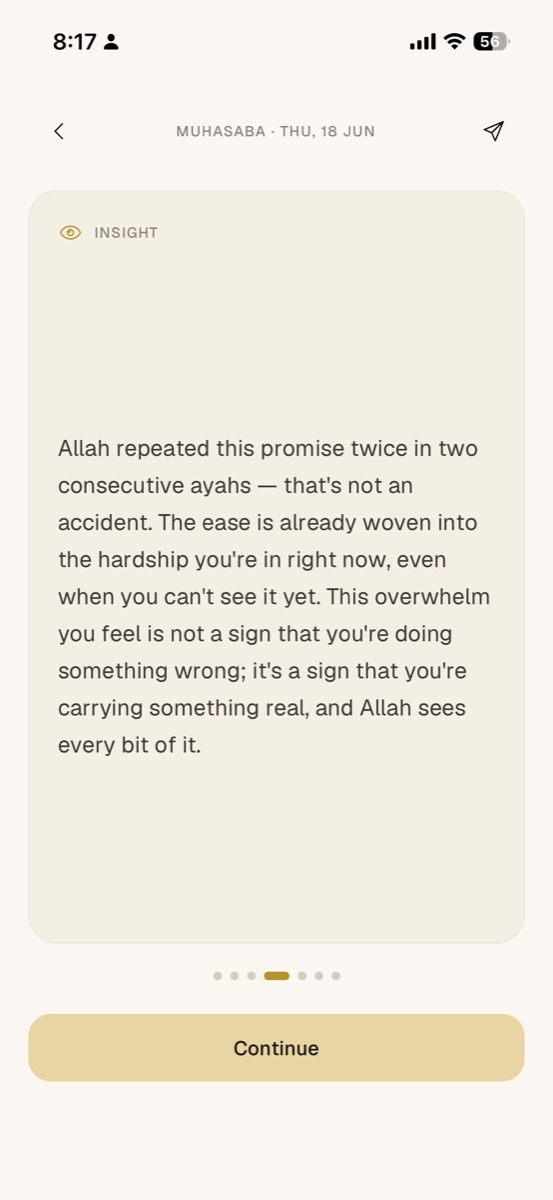
A Quranic ayah specific to your reflection
The AI identifies the central theme of what you wrote — patience, gratitude, guilt, fear, ambition — and returns a Quranic verse that addresses that theme directly. Not a general inspirational quote. A verse that responds to what you actually shared. The difference is perceptible on the first night you use it.
An empathetic acknowledgment
Before the insight comes the acknowledgment. The AI reflects back what it heard in your words — not to reframe it or minimise it, but to confirm that what you experienced was received. This matters more than it might sound. The muhasaba tradition always begins with honest seeing, before resolution.
An insight drawn from the tradition
The insight connects your specific day to a broader principle from Islamic scholarship. It might draw from Al-Ghazali's understanding of the nafs, from Ibn Al-Qayyim's analysis of grief and gratitude, or from a hadith that illuminates the virtue you were practising or struggling with. The source material is always named.
One small action for tomorrow
The action is concrete, specific to what you wrote, and small enough to actually do. Not 'be more patient.' Something more like: before responding to the next difficult message, pause for thirty seconds and make du'a. Small, specific, and tethered to the real circumstances of your day.
A dhikr to close
The session closes with a dhikr — a remembrance of Allah chosen for its relevance to what you reflected on. For a session centred on guilt, it might be Astaghfirullah. For one centred on fear about the future, it might be a specific tasbih. The closure is intentional, not cosmetic.
The key design decision was not to make the AI feel impressive. It was to make it feel grounded. A response that cites a fabricated ayah is worse than no response. A response that sounds wise but is untethered from actual Islamic scholarship provides comfort without substance. Every piece of source material the AI draws from is verified against authenticated hadith collections and standard Quranic tafsir before being included in the response corpus.
What is virtue tracking, and why does it matter?
Research on habit formation consistently shows that tracking behaviour over time produces better outcomes than tracking single-session effort. A 2021 study published in the British Journal of General Practice found that longitudinal self-monitoring improved behaviour change adherence by 28% compared to single-session reflection (BJGP, 2021). Islamic character development works by the same principle: virtues are built through consistent observation, not one-time declarations.
Muhasaba identifies four core virtues across your reflections over time: sabr (patience), shukr (gratitude), tawbah (repentance), and tawakkul (trust in Allah). These are not arbitrary. They are the four virtues the classical scholars placed at the centre of muhasaba al-nafs, and the four that most reliably mark the character of a Muslim who is growing rather than stagnating.
Sabr
PatienceAppears when you write about difficulty, frustration, or sustained effort under pressure. Over time, the frequency and quality of sabr in your entries shows whether your patience is growing or thinning. The Quran mentions sabr in over 90 ayat — the scholars understood it as the foundational virtue.
Shukr
GratitudeAppears when you name blessings, notice what went well, or express thanks to Allah. Most people are surprised to see how infrequently shukr appears in their early entries. The longitudinal view makes the blind spots visible in a way a single journal entry never could.
Tawbah
RepentanceAppears when you acknowledge shortcomings, express remorse, or describe turning back toward Allah. Regular tawbah is a sign of spiritual health, not weakness. The Prophet (peace be upon him) said he sought forgiveness more than seventy times a day (Bukhari). Its presence in your reflections is a measure of honesty.
Tawakkul
Trust in AllahAppears when you release outcomes, acknowledge your limits, or describe placing your affairs in Allah's hands. Its absence over many entries often signals the anxiety and hustle-orientation the scholars warned against.
The longitudinal view is what matters. Any single night of reflection tells you something about that day. A month of tracked virtue data tells you something about your character. Six months tells you whether your character is developing in the direction your niyyah intended. That kind of honest mirror is something no daily mood tracker or weekly review provides.
For a broader look at where Muhasaba fits within the full Islamic app ecosystem, the best Islamic apps guide compares prayer, Quran, and journaling tools together.
How is the Islamic accuracy of the AI validated?
This is the right question to ask of any AI Islamic app, and one most do not answer transparently. Muhasaba's AI responses are generated by Anthropic's Claude API, with a system prompt that specifies the scholarly framework, the permitted source material, and the rules for citation. The permitted sources are: the Quran (with standard tafsir references), the six major hadith collections (Bukhari, Muslim, Abu Dawud, Tirmidhi, Nasai, Ibn Majah), and the classical works of the major scholars — Al-Ghazali's Ihya, Ibn Al-Qayyim's Madarij al-Salikin and Zad al-Ma'ad, Ibn Rajab's Jami al-Ulum, and al-Muhasibi's Ri'aya li Huquq Allah.
The AI is instructed never to fabricate an ayah, never to cite a hadith without a named collection, and never to attribute a statement to a scholar it cannot locate in the specified corpus. When the AI is uncertain about a citation, it is instructed to omit it rather than estimate. This is a hard constraint, not a preference.
The system has been reviewed by the founder — a practising Muslim with working knowledge of the Islamic scholarly tradition — and tested across several hundred reflections covering the full range of virtue dimensions. No formal scholarly advisory board has been convened. That is an honest limitation. The app is the work of one developer, not an institutional project. What it has is a serious attempt at accuracy, a transparent constraint architecture, and a hard commitment not to fabricate.
Is your data private in an AI journal app?
Most large AI applications — including consumer chatbots and several mainstream journaling apps — train their models on user-generated content by default. A 2023 Stanford Internet Observatory report found that 68% of AI consumer apps with free tiers used conversation data for model training unless users explicitly opted out (Stanford Internet Observatory, 2023). Most users never opt out, because most users never read the terms.
What you write in a muhasaba is among the most private content you will ever produce. It contains your sins, your doubts, your moments of spiritual failure, and your honest accounting before Allah. The question of who else can read it is not a minor technicality. It is a matter of spiritual integrity.
Muhasaba's privacy commitment is specific and unconditional. Your reflections are never used to train the AI. They are never read by staff. They are deletable at any time, individually or in bulk. The AI processes your entry to generate a response, and that is the full extent of what happens to your words. Nothing is retained for model improvement. Nothing is sold. Nothing is analysed in aggregate to serve advertisers.
This is a deliberate contrast to the general AI app model. The economics of most free AI products depend on data. Muhasaba's product depends on your trust. Those are different constraints, and they produce different outcomes for your privacy.
Frequently asked questions
What is an AI Islamic journal?
An AI Islamic journal uses artificial intelligence to respond to your reflections using sources from the Quran and authentic Sunnah. Unlike generic AI journaling apps — which draw on positive psychology or CBT — an AI Islamic journal grounds its responses in the Islamic scholarly tradition. It offers relevant Quranic ayat, hadith, and virtue-based insight specific to what you wrote, not generic wellness content.
How does Muhasaba use AI?
Muhasaba's AI generates five elements after every reflection: a Quranic ayah directly relevant to what you wrote, an empathetic acknowledgment of your day, an insight from the Islamic scholarly tradition, one small action to carry into tomorrow, and a dhikr to close the session. The AI reads your specific entry — it does not pull random quotes or use generic templates.
Is voice journaling better than writing for Muslims?
Speaking produces roughly 150 words per minute compared to 40 words per minute for typing. For the muhasaba reflection after Isha — when you are tired — voice lets you articulate things you might not bother typing. Muhasaba transcribes audio using Whisper, so your spoken words become a readable, searchable entry without extra effort.
Is my data private in Muhasaba?
Yes. Your reflections are never used to train the AI, never read by staff, and can be deleted at any time. This is a deliberate contrast to most AI apps, which use your inputs to improve their models by default. The spiritual content of a muhasaba belongs only to you and to Allah.
What is the best AI journal app for Muslims?
Muhasaba is the only AI journal app built specifically around muhasaba al-nafs. Its AI responses are sourced from the Quran and authentic Sunnah rather than generic wellness frameworks. It supports written and voice journaling, tracks virtue patterns over time, and keeps your reflections completely private. Free on iOS.
Starting tonight
The gap between a generic AI journal and an Islamic one is not a marketing difference. It is a difference in what the technology is fundamentally trying to do. Generic AI journaling optimises for emotional regulation and psychological resilience. Islamic AI journaling serves the muhasaba al-nafs: honest examination of the soul, grounded in the Quran and Sunnah, leading to tawbah and resolve.
Both have value. They are not the same thing. A Muslim deserves a tool built for the practice they are actually trying to maintain, not a secular tool retrofitted with Islamic language.
The best moment to begin is after Isha tonight. Not because the app is perfect, but because the practice does not wait for the perfect condition. The scholars built their muhasaba in candle-lit rooms with nothing more than honest intention. The AI just makes that honesty more useful. For the feature-by-feature view, see the Quran journal app overview.
Start tonight
The AI journal app built for the Muslim soul.
Write or speak after Isha. Muhasaba's AI responds with a Quranic ayah specific to your reflection, an insight from the scholarly tradition, one action for tomorrow, and a dhikr to close. Virtue patterns tracked over time. Reflections never used to train AI. Free on iOS.
Download on the App StoreComparing your options? See the honest Muslim journaling app comparison →