Updated August 2026
The Best Muslim Journaling App (2026)
Seven Muslim journaling apps compared honestly: what each one does, what it costs, where it falls short, and which one fits your practice.
By Zaman Ishtiyaq, founder of Muhasaba · Updated August 2026

Quick answer
If you want AI-guided muhasaba al-nafs rooted in Quran and Sunnah, Muhasaba is the only option built for that. No other Islamic journaling app generates guidance from what you actually wrote.
For verse-centred reflection: Qur'an and Me. For Quranic deep reflection: Tadabbur. For gratitude and heart practice: Qalb. For gentle prompted journaling: Saraly. For private unseen practice: Sirr. For spiritual-light journaling: Nuur Journals.
A note on this comparison
I built Muhasaba, one of the seven apps reviewed here. I have tried to be honest about what each does well and where each falls short — including Muhasaba's limitations. No payment was taken from any developer for placement or coverage.
How I evaluated each app: I downloaded and used all seven personally over multiple weeks, assessed the Islamic methodology at the centre of each, tested prompt quality against the practice each app claims to serve, and checked privacy positioning. Pricing was verified from each app's App Store listing as of August 2026; where it appears as “not listed,” the developer did not clearly state it on their website or in the App Store at the time of testing.
For a broader look at the Islamic app landscape, see our best Islamic apps comparison covering prayer, Quran, habits, and journaling together.
All 7 Muslim journaling apps at a glance
| App | Focus | AI | Voice | Price | Platform |
|---|---|---|---|---|---|
| Muhasaba | Daily muhasaba al-nafs | Yes | Yes | Free + Pro | iOS |
| Qalb | Gratitude & the heart | No | No | Free | iOS |
| Sirr | Private spiritual reflection | No | No | Free | iOS |
| Saraly | Gentle prompted journaling | No | No | Free | iOS |
| Nuur Journals | Spiritual light journaling | No | No | Not listed | iOS |
| Tadabbur | Quranic deep reflection | No | No | Not listed | iOS |
| Qur'an and Me | Verse-centred reflection | No | No | Not listed | iOS |
“Not listed” = pricing not clearly stated in App Store or on developer's website at time of testing (August 2026).
Android users
All seven apps in this comparison are iOS only. There is no dedicated Muslim journaling app for Android as of 2026. If you are on Android, your best option is a general journaling app — Day One, Notion, or Bear — with a set of Islamic journaling prompts. We have a collection of Islamic journaling prompts → you can use in any app.
Seven dedicated Islamic journaling apps exist in 2026. Each makes a different claim about what Muslim journaling actually is and what it is for. Choosing between them means understanding which practice you are actually trying to build.
يَا أَيُّهَا الَّذِينَ آمَنُوا اتَّقُوا اللَّهَ وَلْتَنظُرْ نَفْسٌ مَّا قَدَّمَتْ لِغَدٍ
Ya ayyuha alladhina amanu ittaqu Allaha waltanzur nafsun ma qaddamat lighad
“O you who believe, fear Allah. Let every soul look to what it has put forth for tomorrow.”
Al-Hashr 59:18
That ayah contains the whole logic of journaling as a Muslim: not therapy, not productivity, not self-optimisation. A reckoning. Umar ibn al-Khattab (رضي الله عنه) gave the same call in practical terms — حَاسِبُوا أَنْفُسَكُمْ قَبْلَ أَنْ تُحَاسَبُوا — “Call yourselves to account before you are called to account” (reported in Al-Ghazali's Ihya Ulum al-Din). Al-Ghazali built a full chapter around this method. Ibn al-Qayyim developed it further in Madarij al-Salikin. The practice is old. The apps are new.
An Islamic journaling app is not the same as a journal with Islamic prompts. The underlying question is different: not “how did I feel today?” but “who was I before Allah today — and what will I carry forward?” That question changes the prompts, the structure, and what a useful response looks like.
For the full classical account of muhasaba al-nafs and how it works, read our explanation of muhasaba al-nafs →
The 7 best Islamic journaling apps, reviewed
Muhasaba
Best for: AI-guided muhasaba al-nafs
Disclosure: I built this app.
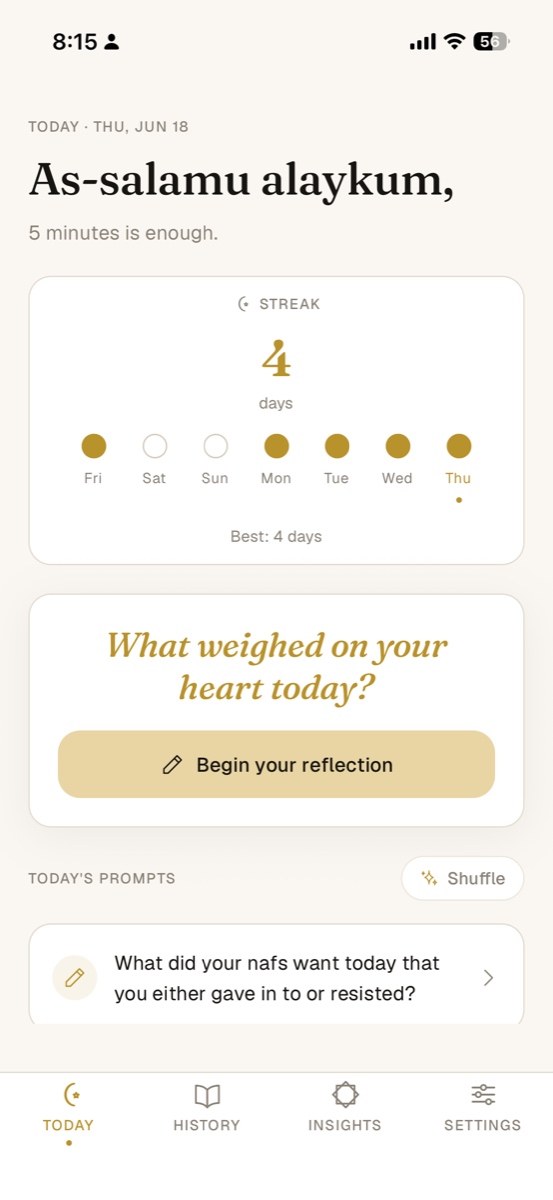
Muhasaba is built around one classical practice — muhasaba al-nafs (مُحَاسَبَةُ النَّفْسِ), the nightly self-accounting that Umar ibn al-Khattab (رضي الله عنه) urged with the hadith: call yourselves to account before you are called to account. The three-step structure — review the day's deeds, acknowledge where you fell short, resolve on correction — comes from Al-Ghazali's Ihya Ulum al-Din and is baked into how the app works, not added as an afterthought.
What it looks like in practice: after Isha, you write or speak a reflection. Voice mode transcribes through Whisper, so you can talk and it converts. You get back a relevant Quranic ayah drawn from what you actually wrote, an acknowledgment of your night, one concrete action for tomorrow, and a dhikr to close with. Over weeks, the app surfaces patterns — how often sabr (صَبْر) comes up in your entries, where tawbah (تَوْبَة) recurs, when shukr (شُكْر) appears — so you can see your inner state across months, not just re-read last night.
Where it falls short: the AI response quality tracks directly to reflection depth. Write two vague sentences and you get a thin response. Write honestly about what actually happened and you get something useful. Muhasaba also has no prayer times, no Quran reader, no habit tracker. That is by design. It does one thing and asks you to do one thing: show up honestly after Isha.
Best for: you journal at night and want the practice to be accountable, not just expressive.
Not for: Android users (iOS only). Anyone expecting a Quran reader or prayer time feature in the same screen.
Free · iOS · 5.0 ★ on App Store · Last tested August 2026
Qalb
Best for: gratitude and heart-centred journaling
Qalb (قَلْب — the Arabic word for heart) does not open with a blank page. It opens with a prompt. Something like: what are you grateful for today that you almost missed? Where did you feel the presence of Allah in your day? The prompts draw on Quranic language about the qalb — the softening of the heart, the return to awareness, the cultivation of shukr. If structured muhasaba feels intense right now, Qalb is designed for where you actually are.
What you get: a consistent, low-pressure daily practice with genuine Islamic framing throughout. What you do not get: any response to what you write. Qalb does not generate guidance, surface patterns across weeks, or connect your entry to a specific ayah from what you wrote. The prompts are fixed rather than adaptive. There is no three-step accountability structure. You fill in the prompt and close the app — and for someone building the habit from scratch, that is probably enough to start.
Best for: establishing a daily Islamic journaling habit when a blank page stops you from starting.
Not for: Those wanting AI responses, Quranic guidance tailored to each entry, or structured self-accounting.
Free · iOS · Last tested August 2026
Sirr
Best for: private, unseen spiritual practice
Sirr (سِرّ) means the inner secret — the private dimension of a person that the scholars described as the seat of real sincerity. The app takes that seriously. There are no streaks, no sharing features, no gamification, no push notifications nudging you back. The interface does not compete for attention. You come when you want to write and leave when you are done. Privacy is not a product feature here; it is framed as a spiritual value, closer to the classical concept of ikhlas in unseen deeds.
Sirr is the right choice if what has been stopping you from journaling is the feeling that digital tools want your data or want to turn your practice into a habit metric. What it does not offer: any structure for the practice itself. No AI response, no review of previous entries to surface themes, no three-step muhasaba framework. If you need privacy plus accountability, Muhasaba also does not sell or share your reflections. If the complete absence of any platform dynamic is specifically what you need, Sirr delivers that.
Best for: Muslims who need journaling to feel private and unseen — not tracked, not gamified, not social.
Not for: Android users (iOS only). Those wanting AI guidance, virtue tracking, or a formal muhasaba structure.
Free · iOS · Last tested August 2026
Saraly
Best for: gentle, prompt-led journaling
Saraly comes from a different instinct than Muhasaba. Where Muhasaba is built around structured accountability, Saraly is built around lowering friction. You open it and find a prompt waiting — thoughtfully written, rooted in Islamic values, asking something gentle about your day, your intentions, your state of heart. The prompt library is broad: gratitude, intention-setting, mood awareness, spiritual reflection, all without locking you into a fixed daily framework.
The design is calm and unhurried. That is Saraly's real value for a new journaler who has not built the habit yet. What it cannot do: respond to what you write. There is no AI guidance, no Quranic ayah drawn from your specific entry, no pattern analysis across weeks. If you have been journaling for a while and want the practice to challenge you, you will outgrow this. Start here if you need to — then decide whether you want more structure.
Best for: someone starting an Islamic journaling practice for the first time who needs a prompt, not a blank page.
Not for: Android users (iOS only). Those wanting AI-generated guidance from the Quran or a structured muhasaba methodology.
Free · iOS · Last tested August 2026
Nuur Journals
Best for: reflection anchored in the theme of divine light
Nuur (نُور — divine light) frames everything in this app. Prompts orbit a single theme: where are you seeking light? Where do you feel it present? Where has it dimmed? The approach is devotional rather than forensic. You are not auditing your nafs so much as turning toward the divine and reflecting on that movement. There is no pivot to generic wellness content — the Islamic anchor holds throughout.
That thematic consistency is what distinguishes Nuur Journals. The prompts feel like they come from a single spiritual vision rather than a committee mixing Islamic and self-help content. What is absent: any AI response to what you write, any framework for identifying shortfalls and resolving them, any tracking of patterns over time. Nuur Journals walks alongside you as a companion — it does not hold you accountable. Whether that is enough depends on what you are looking for in a journaling practice.
Best for: daily reflection anchored in the concept of nuur — particularly if seeking light and closeness to Allah is the centre of your spiritual practice.
Not for: Those wanting structured self-accounting, AI guidance, or a practice that covers the full terrain of muhasaba al-nafs.
iOS · Pricing not publicly listed · Last tested August 2026
Tadabbur
Best for: Quranic reflection through journaling
Tadabbur inverts the usual journaling logic. Most apps start with your day and sometimes bring in a verse. Tadabbur starts with the Quran — a specific ayah — and asks you to bring your life to it. The name comes directly from the Quranic command: أَفَلَا يَتَدَبَّرُونَ الْقُرْآنَ — "Will they not ponder the Quran?" (An-Nisa 4:82). That inversion is intentional and meaningful. You write about how this verse applies to your situation right now, what it illuminates, what response it demands from you.
If Quran study already anchors your spiritual life and you want journaling to extend that engagement, Tadabbur is a strong match. You leave each session having sat with a specific verse and written something real about it. The gap is scope: Tadabbur is a Quranic reflection tool, not a general daily self-accounting journal. If you need to reckon with your anger, your relationships, your character across the day — the muhasaba frame — you will need something alongside it.
Best for: Quran students who want their study to extend into personal written reflection on each verse.
Not for: Those wanting general end-of-day self-accounting, AI-generated guidance, or voice journaling.
iOS · Pricing not publicly listed · Last tested August 2026
Qur'an and Me Journal
Best for: verse-centred personal connection to the Quran
Qur'an and Me Journal is verse-centred like Tadabbur, but the frame is different. Tadabbur leans toward textual engagement — what does this ayah mean? Qur'an and Me leans personal — what does this ayah mean to you, in your life, right now? It is a subtle distinction but you feel it in the prompts. Less about depth into the text, more about connection between a specific verse and a specific moment in your life.
For someone whose relationship with the Quran is the emotional core of their faith, this lands in a way the other apps do not. The entry feels like an extension of reading — you find a verse that speaks to something you are carrying, you write about it, you leave with it settled differently. The honest gap: this is not where you go for comprehensive daily self-accounting. The review-acknowledge-resolve structure of muhasaba al-nafs is not the frame here. If you want Quranic connection and structured accountability, these are two different practices — Qur'an and Me covers one; pair it with something that covers the other.
Best for: Muslims whose faith practice is anchored in the Quran and who want journaling to deepen that personal connection to the text.
Not for: Android users (iOS only). Those wanting structured accountability, AI guidance, or voice journaling.
iOS · Pricing not publicly listed · Last tested August 2026
Which Muslim journaling app is right for you?
If you want AI guidance from the Quran after each entry: Muhasaba. It is the only app that generates a personalised response — Quranic ayah, one action, one dhikr — from what you actually wrote. See our AI Islamic journal guide →
If your journaling practice flows from the Quran: Qur'an and Me or Tadabbur. Both start from a specific verse and invite personal reflection from there. Tadabbur leans more textual; Qur'an and Me leans more personal.
If gratitude is the core of what you want to practise: Qalb. Heart-centred, gentle, grounded in Quranic language about the qalb.
If you are new and need low pressure to start: Saraly. Prompts, calm design, no strict accountability framework — good for building the habit before adding structure.
If privacy is specifically the issue: Sirr. Or Muhasaba, which does not sell or share your reflections either.
If you are on Android: None of these apps run on Android. Use a general journaling app with Islamic journaling prompts → until that changes.
If you want prayer times, Quran reading, and journaling in one app: No single app covers all three well. See our best Islamic apps comparison → for the full picture across categories.
If you are leaving Muslim Pro specifically: its strength is prayer times, not reflection. Our guide to comparing Muslim Pro alternatives covers what each replacement does well — and where journaling fits.
Frequently asked questions
More questions? See our full FAQ →
What is the best Muslim journaling app?
Depends on the practice you want. For structured AI-guided muhasaba al-nafs with Quranic guidance tailored to each entry, Muhasaba is the strongest option. For verse-centred reflection, Qur'an and Me connects journaling directly to the Quran. For gentle prompted journaling, Saraly is accessible and low-friction. For gratitude and heart-centred practice, Qalb. For Quranic deep reflection, Tadabbur. For private minimal journaling, Sirr.
Is there a Muslim journal app with AI guidance?
Yes. Muhasaba is the only Islamic journaling app that uses AI to generate personalised guidance from what you actually wrote or spoke. After each reflection, it responds with a relevant Quranic ayah, an insight about your day, one small action for tomorrow, and a dhikr to close. The guidance is drawn from the Quran and authentic Sunnah — not generic wellness content.
What makes an Islamic journaling app different from a regular journal?
Islamic journaling is rooted in muhasaba al-nafs — the practice grounded in Al-Hashr 59:18, where Allah commands every soul to consider what it has sent forth for tomorrow. A regular journal asks how you felt. An Islamic journaling app frames your reflection through the Quran and Sunnah, addresses shortcomings through tawbah (تَوْبَة), and orients you toward concrete improvement. The accountability is to Allah, not to yourself alone.
Is Muhasaba free?
Yes, Muhasaba is free to download from the App Store. A Muhasaba Pro subscription unlocks unlimited reflections, voice journaling, and virtue pattern insights. The core daily reflection and AI guidance experience is accessible on the free tier.
Is there a Muslim journaling app for Android?
No. As of 2026, all seven dedicated Islamic journaling apps — Muhasaba, Qalb, Sirr, Saraly, Nuur Journals, Tadabbur, and Qur'an and Me — are iOS only. Android users are best served by a general journaling app combined with Islamic journaling prompts until a dedicated Android option launches.
What's the difference between Muhasaba and Qalb?
Muhasaba is built around structured self-accounting (muhasaba al-nafs) — you write about your day, and the app responds with a Quranic ayah drawn from what you actually wrote, one action for tomorrow, and a dhikr. There is an accountability structure with a beginning, middle, and close. Qalb is heart-centred: it opens with a prompt about gratitude or the state of your heart, you write, and you close. No AI response. No pattern tracking. If you want the practice to challenge you and respond to what you wrote, Muhasaba. If you want a gentle daily prompt that keeps you oriented toward Allah, Qalb.
Is there a free Islamic journaling app?
Yes. Muhasaba, Qalb, Sirr, and Saraly are all free to download. Muhasaba's free tier includes the core daily reflection and AI guidance. Muhasaba Pro unlocks unlimited entries, voice journaling, and virtue pattern tracking. Qalb and Sirr are fully free. Nuur Journals, Tadabbur, and Qur'an and Me do not clearly state their pricing in the App Store — check directly before downloading.
What is the best Quran journaling app?
Tadabbur and Qur'an and Me are the two dedicated Quran journaling apps in this list — both start from a specific verse and invite reflection from there. Tadabbur leans more textual; Qur'an and Me leans more personal. Muhasaba is not verse-first, but its AI guidance draws a relevant Quranic ayah from what you actually wrote, so it works well alongside either.
Is there a free Islamic journal app for iPhone?
Yes. Muhasaba, Qalb, Sirr, and Saraly are all free to download on iPhone. All seven apps in this comparison are iOS only as of 2026.
Want to understand the tradition behind muhasaba al-nafs? Read our full explanation →
What is tadabbur and how does it differ from muhasaba? Read our guide to tadabbur →
Looking for a structured gratitude practice? See our Islamic gratitude journal guide →
Want to build a dua journaling habit? Read our dua journal guide →
Want to understand the nafs and how muhasaba works on it? Read about the nafs →
Looking for Islamic journaling prompts to get started? Browse our collection of Islamic journaling prompts →
Want to understand how AI journaling works in an Islamic context? Read our AI Islamic journal guide →
Looking for Islamic apps beyond journaling? See our best Islamic apps comparison →
All seven apps in this list were built within the past few years. The field will keep developing — more platforms, better AI, possibly Android. What will not change is the practice underneath: the nightly reckoning that scholars from Umar to Al-Ghazali to Ibn al-Qayyim described as foundational to the Muslim's inner life.
The right app is the one you will actually open after Isha. Start with whatever lowers the friction enough to begin. Add structure when the habit is settled enough to hold it.
And if data handling is part of your decision — where your reflections go, and who they are sold to — read our Muslim Pro alternatives breakdown before you commit.
Quran journaling apps vs general Muslim journals
A Quran journaling app starts from a specific verse and asks you to reflect on what it means for your life right now. Tadabbur and Qur'an and Me both work this way — you open a verse and write from there. A general Muslim journal usually opens with a prompt about your day or gratitude instead, and only brings in the Quran afterward, if at all.
Muhasaba sits between the two. It is not verse-first like tadabbur practice, but its AI response draws a relevant Quranic ayah from what you actually wrote, so the Quran still grounds every entry. If you specifically want to journal your duas as you make them, a dua journal is a narrower, related practice worth pairing with either approach.
Neither approach is strictly better — they answer different questions. Quran journaling asks “what does this ayah mean for me today?” A general Muslim journal asks “what did I do today, and where did I fall short?” If you already read a portion of the Quran daily, a verse-first app like Tadabbur turns that reading into written reflection with little added friction. If your practice centres more on reviewing your day, Muhasaba's structure fits that rhythm better. Many people use both: Quran journaling in the morning, Muhasaba after Isha.
Try Muhasaba free
The Islamic journaling app built for muhasaba al-nafs.
Write or speak after Isha. Receive a Quranic ayah, an insight, one action for tomorrow, and a dhikr to close. Free to download. No ads.
Download on the App StoreiPhone only · Free to download · Launched 2025